



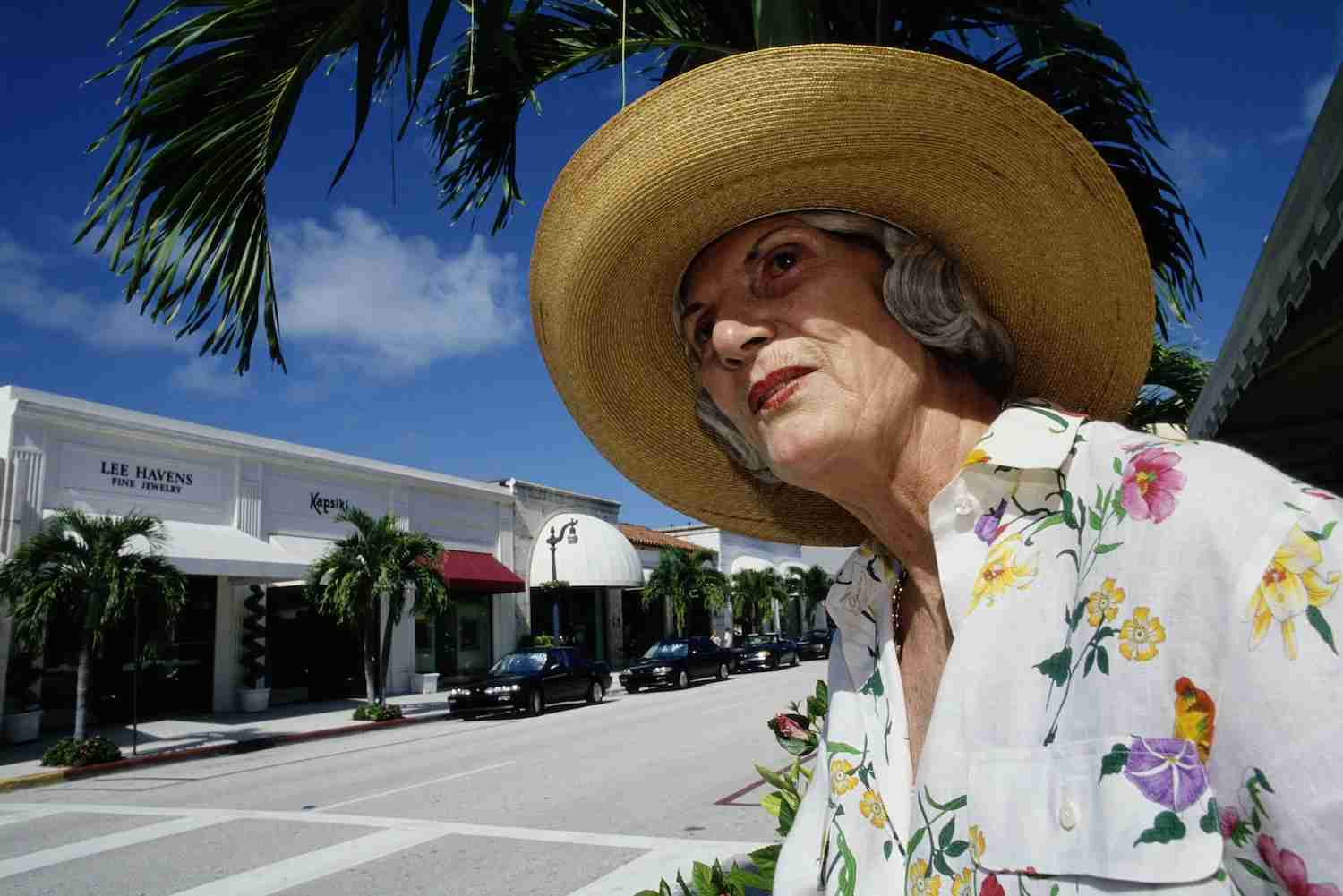
Yes, there are famous exclusive shopping streets across America: Beverly Hills has Rodeo Drive; Chicago has Michigan Avenue; Manhattan has Fifth Avenue. But only Palm Beach can boast one originally conceived by a singular architect’s vision. Worth Avenue, the iconic half-mile (as the crow flies) thoroughfare that spans four blocks from the ocean to the Lake Worth Lagoon, has a rich history intertwined with the development of Palm Beach—a unique blend of commerce, fashion, society, and architectural splendor. And for the island residents who remember the street before global retailers dominated storefronts and have witnessed its various incarnations, Worth Avenue inspires a treasured collection of formative memories.
The street was founded in 1913, after the town had recently been incorporated to stave off possible annexation to less desirable West Palm Beach. It was christened in honor of Major General William Worth, commander of the troops that defeated the Seminoles in 1842. Despite a proper name, it remained a dirt road with a few houses. Its only entrepreneurial outlet was Alligator Joe’s, the area’s first tourist attraction, which featured one hundred ‘gators and crocodiles in a pen, where now stands the Everglades Club golf course. But a few blocks north of Worth Avenue, Palm Beach was already in full swing and had been since 1894 thanks to Henry Flagler, the Standard Oil tycoon and railroad baron who was the mastermind behind turning the exotic barrier island into the country’s premiere winter resort.
Enter two colorful characters in 1918: Paris Singer, heir to the Singer sewing machine fortune, and his pal Addison Mizner, the flamboyant monkey-toting architect. Together, they developed rustic Worth into a commercial thoroughfare for residents and encased it in a Mediterranean-inspired architectural wrapping.
It’s no accident that the transformation coincided with the end of WWI. “It’s important to the development of Palm Beach,” says Rick Rose, who is the official tour guide and historian for the Worth Avenue Association and the author of Palm Beach: The Essential Guide to America’s Legendary Resort Town. “Prior to the war, the French and Italian Rivieras were also major winter resort playgrounds for the affluent. WWI put a grinding halt to all the splendor of Europe.” The war had displaced Singer, whose various villas and mansions across France and England were converted to military hospitals. Arriving in Palm Beach, he discovered a veritable paradise that would be an ideal spot to continue the work he had done in France: building hospitals for the war-wounded. He bought a parcel of land at the street’s west end and convinced his friend Mizner to design and build the Touchstone Convalescent Club for returning Army and Naval officers. Singer, however, was too late. The facility’s completion coincided with the Great War’s Armistice in November 1918, and veterans were eager to return home to their loved ones rather than stop over at a recuperation center.
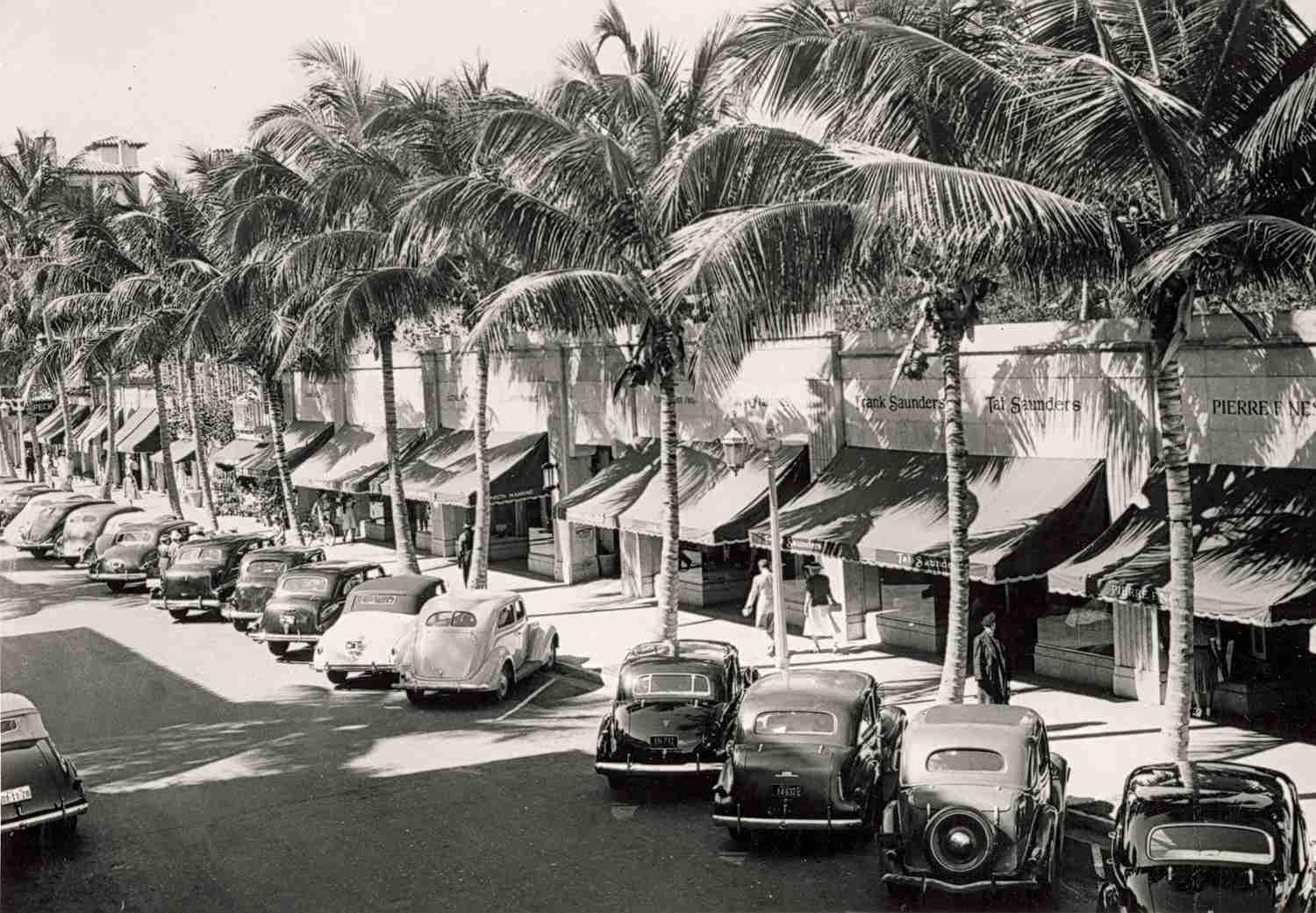
Photo courtesy of the Historical Society of Palm Beach County.
In quick order, Singer repurposed the hospital and turned it into the Everglades Club. Mizner’s design of the club introduced the Mediterranean Revival style and established his success as a pivotal figure in the town’s architectural development. When the Everglades opened in 1919, it started with 25 charter members. By 1921, that number had mushroomed to 500, and the club became an epicenter for Palm Beach’s main social functions: tennis, golf, galas, and balls. “Once the club was built, they had to create luxury goods services and town-serving businesses,” Rose explains. “These activities created a demand.” Singer purchased property adjacent to the club and Mizner returned to the drafting table. On the north side of the street, Mizner implemented the Via concept so prevalent in Mediterranean villages, where alleys and pathways meander off from the main drag to create wonder, uniqueness, and the excitement of never knowing what you’re going to find—or buy. Mizner wanted ambience rather than linear architectural thrill. His travels to Italy, Spain, and Southern France taught him that the architecture there was a blend of different styles—Venetian Gothic, Moorish, and Spanish Renaissance among them.
When Mizner finished his masterpiece, the west end of Worth Avenue, Via Mizner, and Via Parigi all had the patina of a centuries-old village and became the catalyst for what is now called Florida Mediterranean architecture.
While Mizner and Singer were creating their Mediterranean wonderland, luxury retail was already booming at the Fashion Beaux Arts, a lush shopping complex that had opened to great fanfare in 1916 on Lake Trail just north of what is now Bradley Park. Stanley Warrick, its savvy owner, had witnessed the increasing migration of rich, well-dressed winter visitors and declared Palm Beach “the winter fashion capital of the world.” Ultimately, Warrick got greedy. His rising rents sent merchants packing to Worth Avenue, where Singer offered more affordable space. It was also clear to merchants that proximity to the Everglades Club was now the place to be. And unto us, the promised land of shopping was given.
Commercial development coincided with the 1920s land boom in South Florida, which hit Palm Beach like a sparkling meteor. Unpaved Worth morphed into asphalt to make way for motor cars. Rolls-Royce, Cadillac, and Packard dealerships stood next to fashionable stores. The street was officially the island’s premiere high-end shopping district. Venerable retailers in the Northeast saw the value of opening a branch to service what was called the “cottage colony” for winter residents, even though the season at the time was less than three months. Kassatly’s, the bespoke linen store that is still on Worth, opened in 1923 for the winter season to cater to their devoted summer clientele from Hyannis and Southampton. A year later came Cartier (the only branch after New York in America). Saks Fifth Avenue followed suit in 1926 and opened their first store after their Manhattan flagship. Mizner added to his Mediterranean village and built Villa Mizner, his own five-story tower-like residence at the entry to his namesake Via that today can be peered into from a table at Pizza Al Fresco.
By the 1930s, Worth Avenue was a fashion mecca. The Everglades Club began hosting ladies’ fashion show luncheons every Wednesday that included a tombola raffle (proceeds donated to charity) in which some lucky woman won a dress. In addition to established clothing boutiques on the Avenue, the tombolas became a coveted venue for top-tier designers who would come to Palm Beach to show their collections. This “old school” event went on for decades and garnered coverage in the New York Times. The value of the street was clear to the merchants who formed the Worth Avenue Association in 1938. Their mission more than eight decades later is the same: To help the individual shop owners promote the street as an important retail destination. “We’re a nonprofit organization,” says Frank Steinhart, the association’s president. “Ninety percent of the merchants are members. It’s the most unique shopping avenue in the U.S. If you’re here, you could be in Capri, Saint-Tropez, Santorini. There’s nothing like it. We also help to maintain the historic value and integrity of the Avenue.”
The list of famous stores that have graced the Avenue is a luxury retail roll call. Some well known, some forgotten. The swanky Bonwit Teller (the now-defunct New York department store whose memory still makes its former customers misty-eyed) opened in 1935. The legendary Martha, the multibrand couture boutique from New York, became a presence beginning in the 1940s and lasted until the early 2000s. The Elizabeth Arden salon was an early “anchor store” and became the training ground for hairdressers who would later open their own salons on the Island. The high-end stores that populated the Avenue catered to the needs of the Old Guard. “Many of the stores were for very chic, sophisticated older women in their 50s and 60s. You have to remember that there was a black-tie dinner almost every night and it wasn’t a charity gala. Private dinners, openings at the Paramount Theatre or the Royal Poinciana Playhouse, openings at the Wally Findlay art gallery. It was all formal attire,” explains Lesly Smith, the mayor from 2000 to 2005, and who has had roots in Palm Beach since 1954, when her father bought a house on Golfview Road around the corner from Worth Avenue.
Nestled in between were local shops that to to this day resonate with longtime residents. “The Avenue had the most wonderful stores,” recalls interior designer Mimi McMakin, who was born and raised in Palm Beach and is the owner of The Kemble Shop on Hibiscus Avenue. “There was Scott’s, a fabulous dress shop run by Mrs. Scott. The Lullabye Shop was for young children. When you outgrew your smocked dresses, you went next door to the Prep Shop, which also had the exclusive on school uniforms. The Shack is where you went when you hit your teens. There was Stinchfield’s, that sold casual women’s clothing, and the owner always stood outside the store dressed in colorful pants, a cashmere sweater tied around his shoulders, and a Panama hat. I can see it all as clear as day.”
Britty Damgard, who came to Palm Beach as a child to attend school and who serves on the town’s Landmarks Preservation Commission, adds: “Next to Mrs. Scott, her husband had a menswear shop also called Scott’s. Hattie Carnegie was where Chanel is now.” Kate Gubelmann, who moved with her family to Palm Beach in 1960, remembers Au Bon Goût, a shop whose sign outside the Via Mizner location read “Antiques Hors d’oeuvres.” “Harriet Healy had serving pieces, tabletop accessories, she gave cooking lessons, and sold delicious crackers called Flying Saucers in little jars with screw tops. The unique, privately-owned stores gave the Avenue its charming local color,” Gubelmann says. “It had everything. You could buy your booze, your pharmacy items, your clothes, your luggage.” It was mom-and-pop Main Street–meets–Fifth Avenue luxury–meets–Capri’s Via le Botteghe.
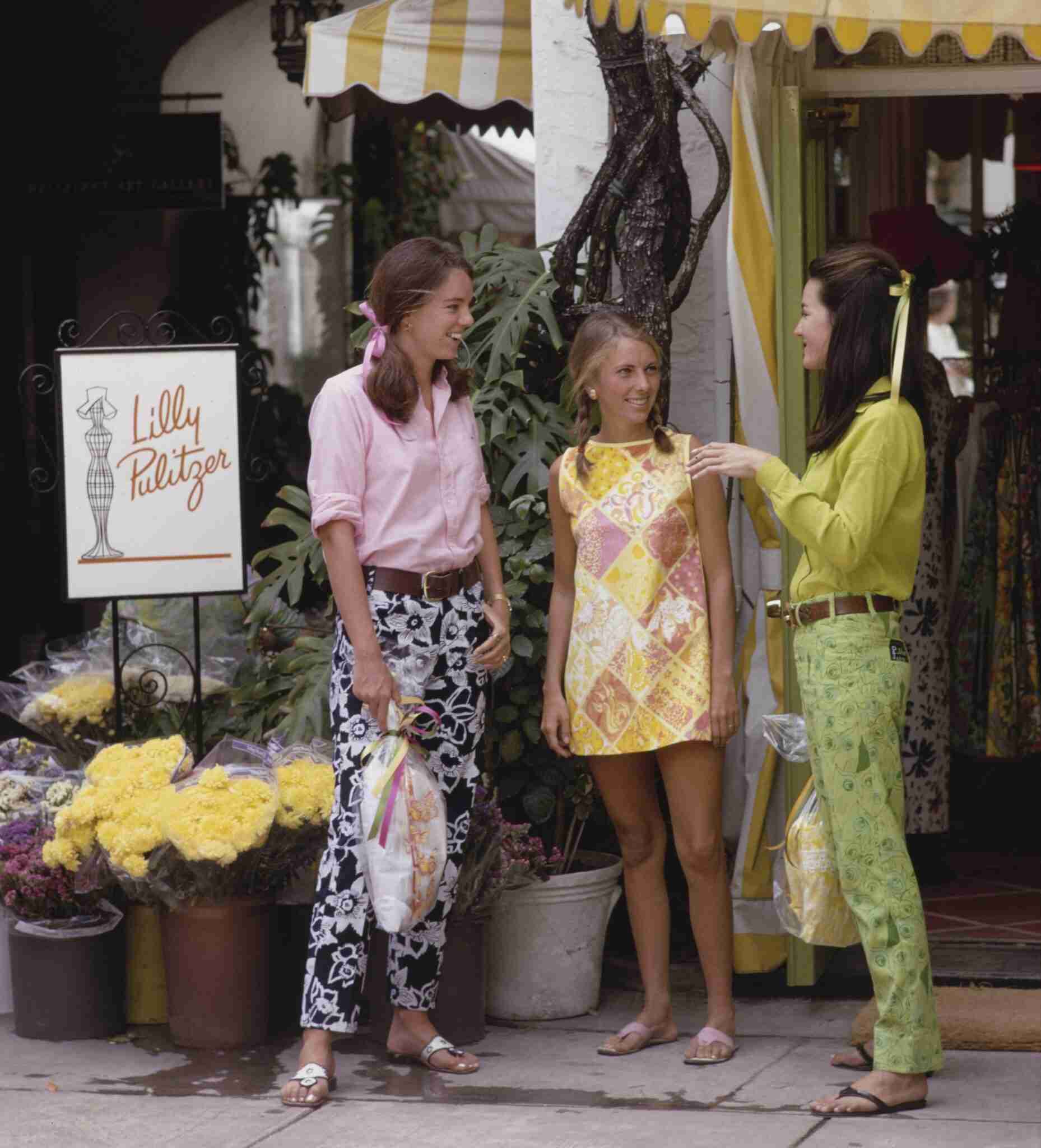
Like so much of Palm Beach’s history, Worth Avenue is about the people. Even more than the individual boutiques, what is remembered by many is the street’s collegial atmosphere. The Avenue was like one big block party. Residents knew the shopkeepers. It was a small-town vibe but often with a socially privileged twist—a blend of professional merchants who had settled in Palm Beach mixed in with well-born shop owners. There is no better example than Lilly Pulitzer (whose great grandfather was one of the founders of Standard Oil), who opened her first shop in Via Mizner in 1962. Her then husband Peter Pulitzer (the publishing heir) owned citrus groves; Lilly set up an orange juice stand in 1959 that was a big hit with the locals. The juice stained her clothes, so she had her dressmaker create cotton dresses to camouflage the mess.
Her juicing uniform became the blueprint for the iconic Lilly shift dress. “My brother, sister, and I really grew up on Worth Avenue,” says Liza Pulitzer, who, today, is one of Palm Beach’s top real estate agents. “The Avenue had a different atmosphere then. We would come into the shop wearing our bathing suits and flip-flops. We were either squeezing juice at the stand or in Mom’s shop pinning up hems or packing the clothes and tying ribbons onto the shopping bags. The whole atmosphere of Worth was relaxed. I remember seeing a photo of my grandfather Tony Pulitzer walking down Worth, wearing a bathrobe, smoking a cigar, and walking his dog.”
While Lilly was selling cheerful frocks, there were other pedigreed sorts manning a cash register. Buddy Davie, another heir to Standard Oil, and his wife Dysie had “343” Worth Avenue, a go-to shop that sold innovative costume jewelry and objets d’art. “It was also a sort of meeting place,” recalls art dealer Cynthia Boardman, who was the managing director of the society-backed Palm Beach Galleries for several years in the 1970s. And then there was socially prominent but roguish Charles Amory, whose shop The Flower Cart supplied the blossoms and decor for many a Palm Beach party, but who is more remembered as a notorious card cheat.
In addition to shopping, there were bars, restaurants, and a robust nightlife. One of the earliest and the most notable spots was Ta-boo, which shuttered in 2023 after eight decades. (It’s scheduled to open in 2025 under the leadership of the renowned chef Thomas Keller.) When Ta-boo opened in 1941, it offered cocktails, food, and slot machines. During the 1950s, ’60s, and ’70s, it was the venue for the annual Coconuts New Year’s Eve party that’s been a cornerstone of the social calendar since the 1930s. Marshall Grant, the town’s premiere society piano player, performed there most evenings, and islanders would dance the night away. It was also the first stop for visiting celebrities. Boardman, whose father Leighton Rosenthal owned the block and was Ta-boo’s landlord, remembers taking family friend Cary Grant there for the first time: “The waitress was so undone by Cary that instead of bringing his order of stone crabs she brought him empty shells.” When revelers tired of Ta-boo, they went up the street to The Alibi, a bar and nightclub. The Loggia bar was another social hub, where a lot of the men in town would meet at 5 p.m. every evening. No culinary history of Worth Avenue would be complete without mentioning Petite Marmite, which had a 40-year run before closing its doors in the 1980s and was heralded by the New York Times as a “gastronomic showplace.” To this day, it can still elicit memories on par with Proust remembering his beloved madeleines. “My favorite dish was the crab fingers meunière with a heavenly mustard sauce,” says McMakin. Bice is now where Petite Marmite once stood.
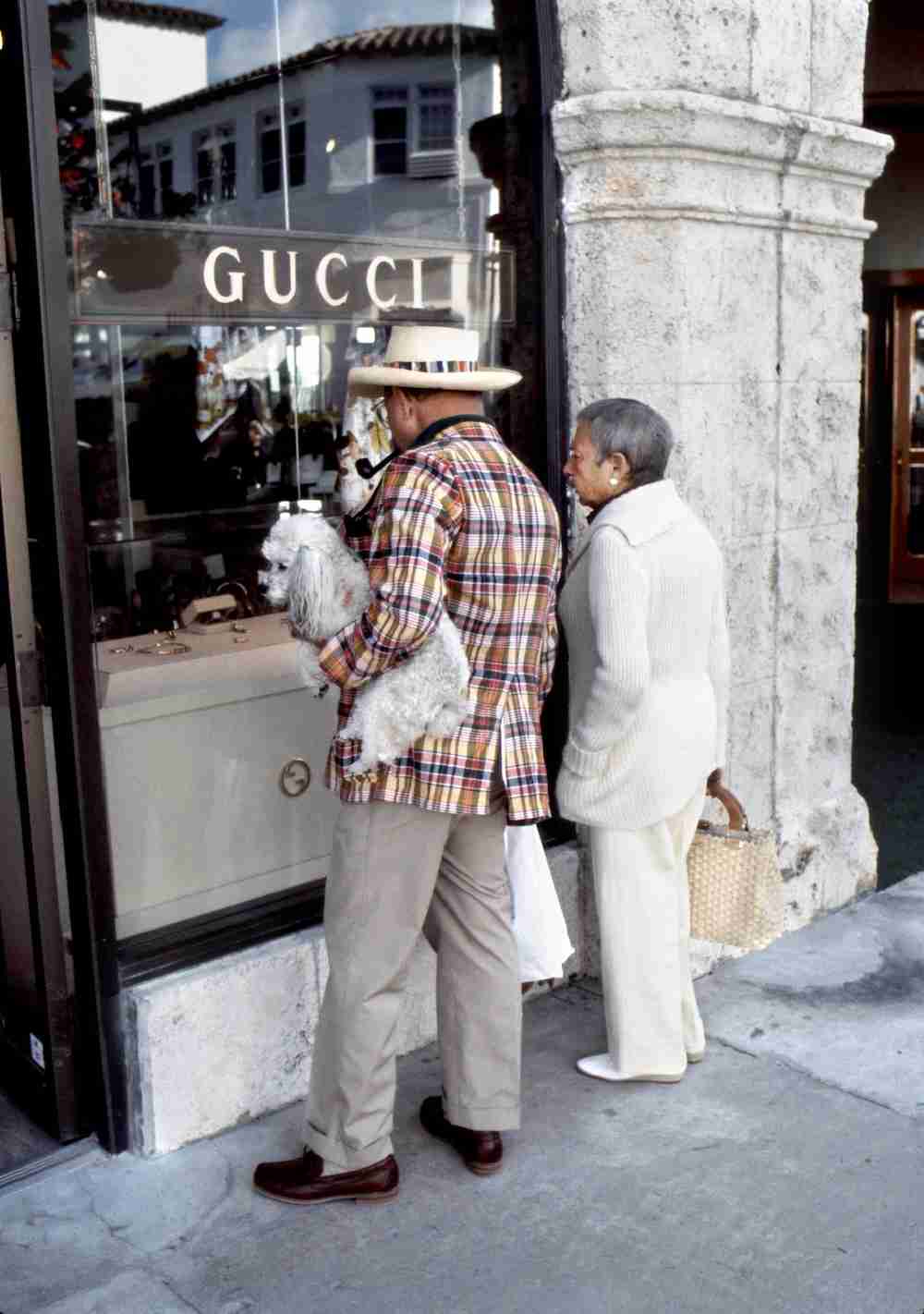
In the 1970s, international brands such as Gucci and Hermès arrived on the Avenue. As per island tradition, the shops shut down with the “season,” which ran from Thanksgiving to Easter. This coincided with the traffic lights being turned off. But Earl E.T. Smith, who served as mayor from 1971 to 1977 (and is Lesly Smith’s late husband), accurately read the tea leaves. He was responsible for making sure the lights stayed up all year. He also encouraged stores on Worth Avenue and businesses throughout Palm Beach to remain open year-round. This was part of his broader effort to modernize the town and ensure that Palm Beach was seen as a vibrant year-round community rather than a seasonal resort.
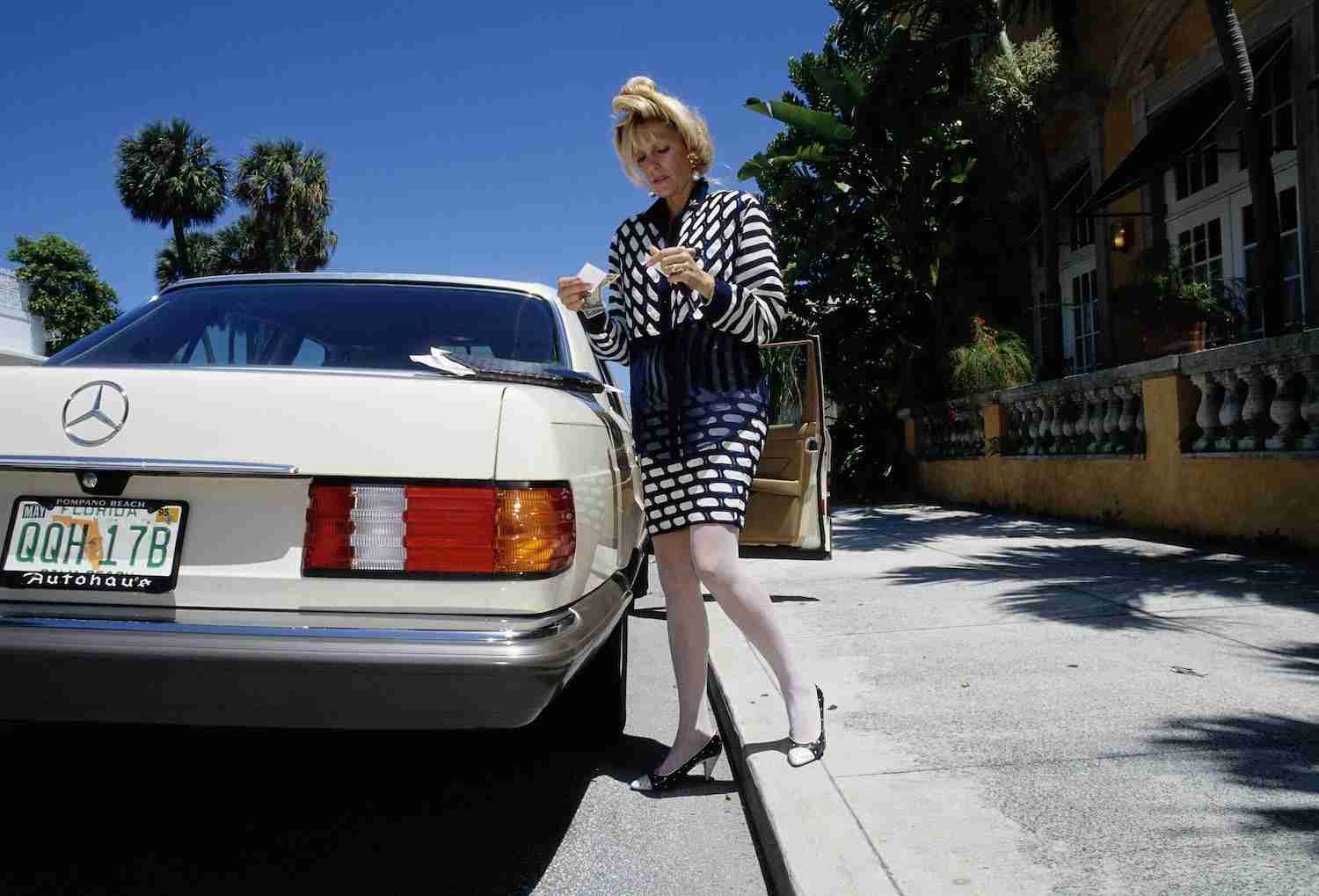
The 1980s saw more transformation, beginning with the Esplanade at 150 Worth Avenue at the east end of the street. The brainchild of real estate developer Murray Goodman, it was the first outdoor luxury retail complex since Mizner. And it was inevitable that there would be push-back. “I remember when he wanted to develop it. Many on the town council said it would never happen. But it did,” says Jane Holzer, who was born and raised on the island and is a third-generation Worth Avenue landlord. (See a profile of Holzer on page 86.) The Esplanade’s Mizner-inspired architecture has aged so gracefully into the Avenue’s landscape that few residents can even remember what existed there before. Answer: A gas station.
The small-town feel with an uptown buzz was still happening. Holzer, a renowned art collector and muse to Andy Warhol, opened Sweet Baby Jane’s, an ice cream shop on one of her commercial properties that sold homemade gelatos with crazy flavors like “Absolutely Nuts.” The opening was attended by Warhol and an entourage of Holzer’s art world and society friends. “It was popular,” she says. “The lines were around the block. But I couldn’t get the help, and I ended up doing a lot of the scooping myself.” Today, Holzer is one of the few individual landlords left on the Avenue. Most are part of larger corporate entities. Her strip of Worth, built by her grandfather in the 1950s, houses three luxury retailers and Le Bilboquet, the New York–based restaurant that opened in 2021 to great excitement. (She is also an investor.)
Harking back to the days of the Duke and Duchess of Windsor in the 1930s, Worth Avenue had always been a magnet for visiting celebrities. And the ’80s were no different.
This story is an excerpt from PALMER Vol.6. To see the complete story, pre-order your copy of the magazine, here.
